Cornea · 19 Sept 2026 · 12 min read
Keratoconus: When “My Number Increased” Needs a Cornea Map
Keratoconus often shows up as a glasses number that will not sit still. How cornea mapping, CXL and transplant decisions work — screening first, ReliveCure books the consult.

A new glasses prescription every few months is not a personality trait. We meet people who have been told “your power increased” three times before anyone mapped the cornea. Keratoconus treatment starts with that map — not with a procedure name from a reel.
ReliveCure evaluates, writes the plan, and when a procedure is the honest next step, matches you to a senior cornea surgeon at an accredited centre in Gurugram, Hyderabad, Pune or Mumbai. We will not promise that corneal cross-linking (CXL) will make you glasses-free.
What keratoconus is, in plain language
Keratoconus is a condition where the cornea — the clear front window of the eye — thins and steepens. Instead of a regular dome, the shape can become cone-like. Light scatters. Glasses that worked last year stop sitting right. Night driving gets harder. Some people notice ghosting or a second faint outline around letters.
Most people searching “keratoconus treatment” did not start with that word. They started with a number that would not stay still, or with a contact lens that would not settle. The procedure names — CXL, rings, transplant — come later, after measurements.
How it shows up in metro work life
Pune, Hyderabad, Mumbai and Gurugram desks are screens, late commutes and AC. None of those causes keratoconus, but they make fluctuating vision easy to blame on “dryness” or “too much laptop”.
A 26-year-old analyst we evaluated had changed glasses twice in eight months and was shopping for LASIK. The map was not a LASIK cornea. That is the point of screening.
Hard eye-rubbing, a family history of “odd corneas”, and poorly fitting contacts are useful clues. They are not a diagnosis. Only the scan is.
What a proper keratoconus evaluation checks
A serious work-up should include more than a glasses number:
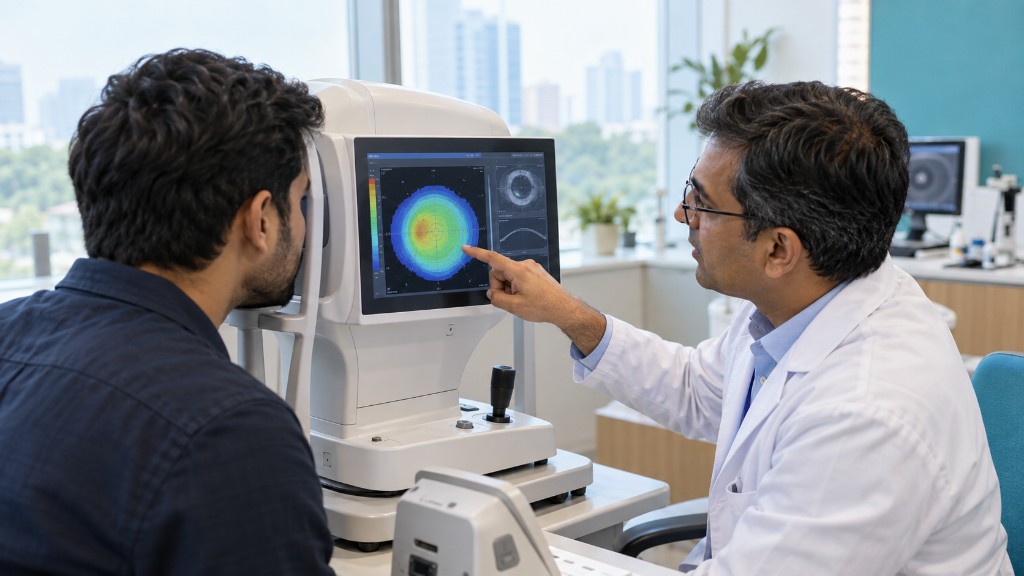
- Corneal topography / tomography — shape and back surface, not just the front
- Thickness map
- Vision with glasses versus rigid or scleral lenses, if you already wear them
- Whether old prescriptions show real progression, not one noisy reading
Only then does “watch, cross-link, or discuss transplant” become an honest fork. You should leave with the pictures explained in language you can repeat to family. Bina pressure ke — no slot booked from fear.
Where corneal cross-linking (CXL) actually fits
CXL stiffens the cornea using riboflavin (vitamin B2) and controlled ultraviolet light. The aim, when it is offered, is to slow or halt progression — not to gift you 6/6 or to replace glasses overnight.
ReliveCure will not promise a refractive result from CXL. If someone does, get a second map.
CXL is not for every keratoconus cornea. Very thin corneas, very advanced cones, active infection, or a shape that is already stable in older patients can all change the plan. Some people are better served by specialist contact lenses first. Some need a transplant conversation because the cornea is past what CXL can reasonably hold.
High myopia without keratoconus is a different fork — sometimes ICL, after the cornea has been cleared as regular. For elective laser context, see the laser eye treatment overview.
When transplant enters the conversation
Advanced scarring, very steep cones, or hydrops (a sudden clouding after a break in the inner layers) may lead a cornea specialist toward partial or full thickness transplant (DALK or PK, among other techniques). Tissue availability, recovery time and rejection risk are real. This is not a “package” sold on day one.
Our corneal transplant guide covers that fork in more depth.
Specialist lenses while you decide
Many people with keratoconus see their best vision in rigid gas-permeable or scleral lenses, not in another pair of soft contacts or a rush to theatre. Lenses do not stop progression. They can still be the right vision plan while serial maps decide whether CXL is even on the table.
How ReliveCure sits here
You book the consult with us — Gurugram, Hyderabad, Pune, Mumbai, or another metro we already serve. ReliveCure is the care team: the map, the written plan, the match to a senior cornea surgeon at an accredited centre when a procedure is the fit. Call +91 96500 23161.
What to do this week if this sounds like you
Bring old prescriptions. Stop assuming every power jump is “normal myopia”. Do not rub the eyes as a habit. Do not book LASIK from an ad while the shape is unmapped.
If you already have a keratoconus label from another clinic, a second map is still reasonable — especially before CXL.
Myths
“CXL is a type of LASIK.” Different intent. LASIK reshapes for glasses. CXL tries to stabilise a thinning cornea.
“If I have keratoconus I will definitely need a transplant.” Many people never do.
“One scan is a lifetime diagnosis of speed.” Progression is a series of maps.