Insurance · 22 Sept 2026 · 12 min read
Eye Surgery Insurance in India: Function Gets Paid, Appearance Does Not
Insurers ask one question — function or appearance. Day care is not an exclusion. What Indian health policies usually cover for eye surgery, which notes win the claim, and where ReliveCure books the evaluation.

Does health insurance cover eye surgery in India? Usually yes when the surgery restores or protects function, and usually no when the file reads as appearance or convenience. Most questions about eye surgery insurance in India come down to one file. Here are two, put together from the kind of claims we see all the time. Two patients have the same upper-lid surgery for drooping lids that block the top of their vision. In the first file, the discharge summary says "elective procedure for cosmetic improvement." The insurer rejects it within days. In the second file, there is a visual-field printout showing the field lost with the lids untaped and regained with them taped, a photo of the lid margin sitting over the pupil, and an acuity record. That claim is paid.
Same surgeon, same operation, same policy wording. The only thing that changed was what the notes said.
That is the whole game, and most families learn it too late. It is decided in the clinical notes, not at the billing counter, and a cosmetic-worded discharge summary cannot be fixed afterwards by adding a test.
The one question every insurer is asking
Indian health insurers do not start by asking what the surgery is called. They ask one thing: is this restoring or protecting function, or is it changing appearance?
Function is paid. Appearance is not.
A cataract that has dropped your acuity, glaucoma that is eating your field, a cornea that has scarred over, a lid that blocks the pupil. These are function problems, and policies are written to cover them. Smoothing a lid crease, filling a hollow, or getting rid of glasses because they are inconvenient are appearance or convenience choices, and policies are written to exclude them.
The hard part is that many eye surgeries sit on the line between the two. Upper-lid surgery is the classic case. So is squint surgery in adults, and some corneal procedures. The claims assessor never sees you. They see paper. If the paper shows measured loss of function, the case reads as medical. If it shows a patient who "wanted to look better", it reads as cosmetic, whatever your eye is really doing.
This is why the notes describe what was measured, not what was wished for. You can read more about the lid-specific version of this in our guide to eyelid ptosis and blepharoplasty.
Day care is not an exclusion
This is the second thing families get told wrong, often at a front desk: "It's a day-care procedure, so insurance won't pay."
For listed ophthalmic procedures, that is not how it works. Most modern Indian policies carry a day-care list, and eye procedures make up a large part of it. That includes intravitreal injections, retinal and glaucoma lasers, pterygium excision, DCR (tear-duct surgery), and many lid procedures. Cataract surgery has been day care for years.
Staying overnight is not the test. The test is whether the procedure is medically necessary and appears on the policy's day-care list, or falls under its general in-patient cover. Nobody should keep you in a bed overnight to make a claim "look" admitted. That does not help, and it can make an otherwise clean file look suspicious.
If a hospital or TPA desk has told you day care is not covered, ask them to show you the exact clause. Usually there isn't one.
What is almost never covered
Honesty up front saves arguments at the pre-auth stage. These are the items that usually fall outside a standard Indian health policy:
- Spectacles and contact lenses. This includes scleral lenses, even when they are medically necessary for keratoconus or a damaged corneal surface. It is a frustrating gap, but it is standard.
- OPD consultations and diagnostics. OCT scans, visual-field tests, angiography and routine consultations usually are not reimbursed unless you have an OPD rider. They become part of a claim only when they happen inside a covered hospitalisation or day-care episode.
- Pharmacy at home. Long-term glaucoma drops, dry-eye treatment and immunosuppressants taken at home are usually on you, even though they are what keeps the condition controlled.
- Cosmetic lid work, fillers, botox. These are excluded as appearance procedures.
- LASIK and other refractive surgery done for convenience. Most policies exclude it. If you are weighing refractive surgery, start with LASIK screening — suitability first, not a claims promise.
None of this means the underlying care is optional. It means the policy was not designed to pay for it. Bring the policy to the evaluation anyway — we tell you what is likely claimable and what you should budget, without a guess.
The three phrases that get claims rejected
We teach families these phrases so they can spot them. We never write them in our own plans.
- "For cosmetic improvement." One line like this can sink a file that otherwise documents real field loss.
- "Patient desired better appearance." It frames a function problem as a preference. Assessors read it literally.
- "Elective procedure." In clinical shorthand it just means "scheduled, not emergency." In a claims file it reads as "optional." Scheduled sight-saving surgery is still sight-saving.
If you see any of these in a draft discharge summary or pre-auth form, raise it before signing. Ask the treating doctor to describe the measured deficit instead. Do not ask them to exaggerate. Ask them to record what the tests actually showed. Once the discharge summary is issued with cosmetic wording, adding a field test later rarely rescues the claim.
Master coverage table
| Category | Usually covered? | What makes or breaks the claim |
|---|---|---|
| Sight-saving / function-restoring surgery (cataract, glaucoma, retina, cornea) | Yes, as in-patient or day care | Acuity, grading, field or pressure records in the file |
| Accident / trauma | Yes, typically without the pre-existing-disease wait | Clear accident history and documentation |
| Ocular cancer | Yes | Also check any separate critical-illness policy |
| Congenital / paediatric surgery | Usually | Watch the ~90-day newborn wait unless there is a maternity rider; RBSK / Ayushman can fill a gap |
| Functional upper lid / ptosis | Often | Taped-vs-untaped field printout plus lid-over-pupil photo |
| Cosmetic lid surgery, fillers, botox | No | Appearance, not function |
| LASIK / refractive for convenience | Usually no | Read the policy; do not assume cover |
| Spectacles, contacts, sclerals | No | Excluded even when medically necessary |
| OPD consults, OCT, fields, angiography | No, without an OPD rider | Covered only inside an admitted or day-care episode |
| Home drops and oral medicines | Usually no | Long-term pharmacy sits outside most policies |
Policies vary, and this table is a pattern, not a promise. Every case has to be checked against the patient's own policy schedule and exclusions. We will break out uveitis and trauma cover in separate guides.
Documents that must exist before surgery
The file is built before the operation, not after. What it should contain depends on the procedure:
- Visual acuity, best-corrected, recorded for each eye.
- Cataract grading or a clear note on how the lens opacity affects daily vision. The detail is covered in our cataract surgery guide.
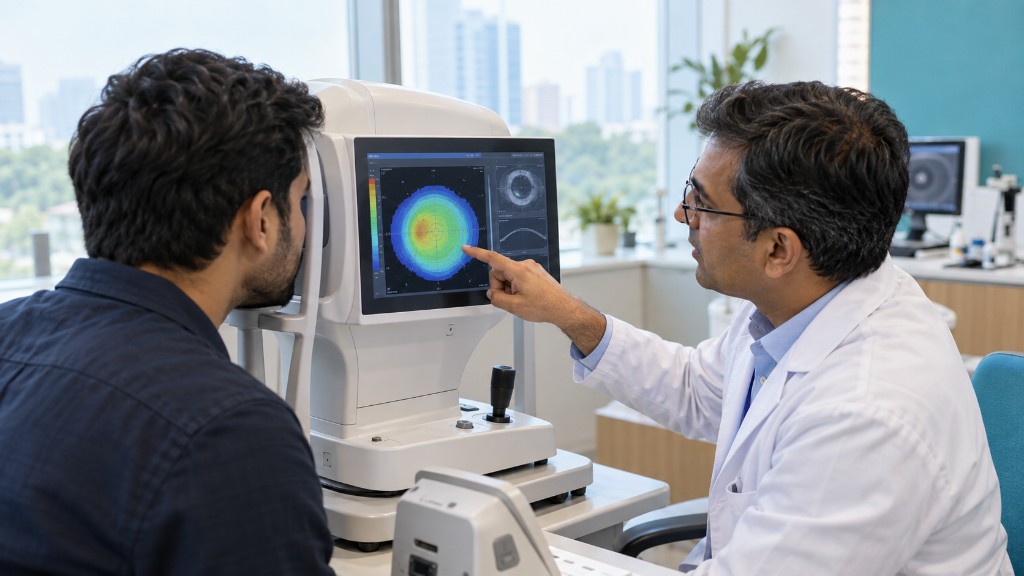
- Visual-field printouts. For glaucoma, these show progression (see glaucoma surgery). For lids, they need to be taped and untaped.
- Clinical photographs where anatomy is the argument, such as the lid margin against the pupil.
- Corneal findings and topography for scarring, thinning or failed grafts. Our corneal transplant guide explains why these matter.
- Paediatric records: birth history and when the condition was first noticed. The paediatric eye surgery guide covers timing.
- Policy copy, e-card and ID, plus the date cover started if waiting periods might apply.
Keep copies. A TPA query sent to you three weeks later is much easier to answer with your own set.
Where ReliveCure fits
You come to ReliveCure in Gurugram, Hyderabad, Pune, Mumbai, or another metro we already serve. We do the evaluation, get the functional tests into the file, and take you through surgery when that is the honest next step.
We check your policy at that visit. We do not guess cover, and we do not write a cosmetic case as if it were medical. Exact cost and exact cover come after the evaluation, not before. Pehle jaanch, phir faisla. Check first, then decide. Book a free eye evaluation — call +91 96500 23161.